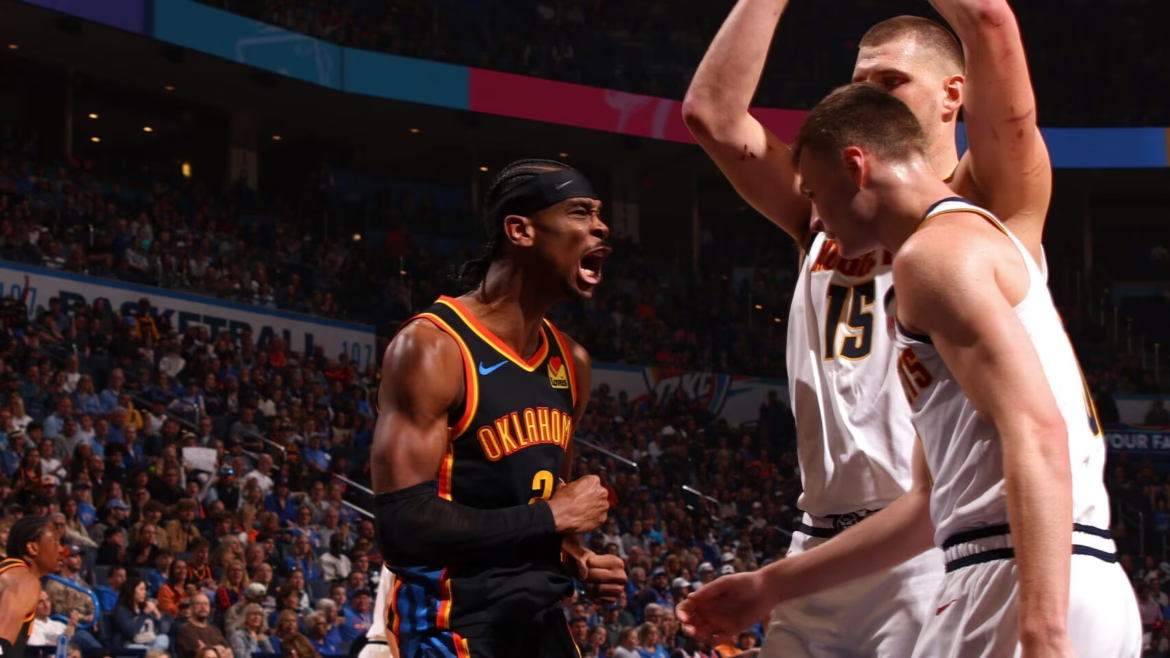
The Denver Nuggets vs OKC Thunder match player stats reveal a fascinating clash between experience and youthful energy, making this matchup one of the most analytically rich contests of the season. Denver entered the game with a championship-tested core built around Nikola Jokić, Jamal Murray, and Michael Porter Jr., while Oklahoma City relied on speed, spacing, and the breakout brilliance of Shai Gilgeous-Alexander. From the opening tip, both teams imposed their identities, and the box score tells a layered story of efficiency, volume scoring, defensive adjustments, and bench impact. Examining player stats in detail helps explain how momentum shifted and which individual performances ultimately defined the outcome.
Nikola Jokić’s Statistical Masterclass for Denver
Nikola Jokić once again proved why he remains the engine of the Nuggets, with the Denver Nuggets vs OKC Thunder match player stats highlighting his all-around dominance. Jokić posted a near triple-double, combining high-percentage scoring in the paint with elite playmaking from the high post. His points came through a mix of post hooks, short floaters, and timely three-point shots that forced OKC’s defense to collapse. Beyond scoring, his rebound numbers were crucial in limiting second-chance points for the Thunder. Jokić’s assist total underscored his vision, as he repeatedly found cutters and shooters when double-teamed. Defensively, while not flashy, his positioning disrupted OKC’s driving lanes, making his stat line one of the most impactful in the game.
Jamal Murray’s Scoring and Playmaking Contribution
Jamal Murray’s stats in the Denver Nuggets vs OKC Thunder match player stats column reflect his importance as Denver’s secondary star. Murray delivered clutch perimeter scoring, particularly in stretches where OKC threatened to seize control. His shooting splits showed confidence from mid-range and beyond the arc, and his ability to score off the dribble kept OKC’s guards under pressure. Murray also contributed with assists, running effective pick-and-roll actions with Jokić that repeatedly forced defensive switches. While his defensive stats may not dominate the box score, his on-ball defense and ability to fight through screens played a subtle but vital role in slowing OKC’s offensive rhythm.
Michael Porter Jr. and the Importance of Efficient Shooting
Michael Porter Jr.’s performance stands out in the Denver Nuggets vs OKC Thunder match player stats due to his efficiency rather than sheer volume. Porter capitalized on open looks created by Jokić and Murray, knocking down three-pointers at a high rate. His rebounding numbers, particularly on the defensive end, helped Denver maintain control during key stretches. Porter’s length also allowed him to contest shots effectively, even when switched onto smaller OKC guards. Though he may not have led the team in scoring, his balanced stat line reflects his growing role as a reliable third option in high-level matchups.
Aaron Gordon’s Two-Way Impact
Aaron Gordon’s stat contribution in the Denver Nuggets vs OKC Thunder match player stats demonstrates the value of versatility. Offensively, Gordon scored efficiently around the rim, benefiting from cuts and transition opportunities. His free-throw attempts highlighted his aggressiveness when attacking mismatches. On defense, Gordon often drew the assignment of guarding Shai Gilgeous-Alexander, and while SGA still produced strong numbers, Gordon’s physicality made scoring more difficult. Gordon’s rebound and steal totals illustrate his activity level, making him a crucial glue player whose impact goes beyond traditional scoring metrics.
Shai Gilgeous-Alexander’s Star Performance for OKC
Shai Gilgeous-Alexander was the focal point of the Thunder’s offense, and the Denver Nuggets vs OKC Thunder match player stats confirm his superstar-level output. SGA led all scorers, showcasing his elite ability to score at all three levels. His drives to the basket resulted in a high number of free-throw attempts, reflecting his knack for drawing contact. He also contributed assists, finding teammates when Denver collapsed on his penetration. Defensively, SGA added steals by anticipating passing lanes, further underlining his two-way value. Despite Denver’s defensive focus on him, his efficiency and volume kept OKC competitive throughout the game.
Chet Holmgren’s Influence in the Paint and Beyond
Chet Holmgren’s stats in the Denver Nuggets vs OKC Thunder match player stats highlight his unique role as a modern big man. Holmgren provided rim protection, recording multiple blocks that altered Denver’s shot selection. Offensively, he stretched the floor with his three-point shooting, pulling Jokić away from the basket and opening driving lanes for guards. His rebounding numbers were solid against a physically imposing Denver frontcourt, and his ability to score both inside and outside made him a constant matchup problem. Holmgren’s stat line reflects a rookie—or young star—playing with composure well beyond his years.
Jalen Williams and OKC’s Secondary Scoring
Jalen Williams emerged as a key contributor in the Denver Nuggets vs OKC Thunder match player stats, offering reliable secondary scoring for the Thunder. Williams attacked closeouts effectively, finishing at the rim and hitting timely jump shots. His assist numbers indicate improved playmaking, particularly when sharing the floor with SGA. Defensively, Williams used his length to contest shots and generate deflections, contributing to OKC’s transition opportunities. His balanced stat line underscores his importance in alleviating offensive pressure from SGA and maintaining OKC’s pace-oriented style of play.
Bench Production and Rotational Impact
The bench statistics within the Denver Nuggets vs OKC Thunder match player stats reveal a contrast in rotational strategies. Denver’s bench focused on maintaining stability, with players contributing modest scoring and strong defensive effort. Key reserves provided energy, rebounding, and timely shooting, ensuring that the starters could rest without sacrificing momentum. OKC’s bench, on the other hand, emphasized speed and spacing, with younger players pushing the tempo and attempting to swing momentum with quick scoring bursts. While OKC’s bench showed flashes of brilliance, Denver’s depth and experience translated into more consistent production across extended minutes.
Turnovers, Fouls, and Possession Control
A deeper look at the Denver Nuggets vs OKC Thunder match player stats reveals how turnovers and fouls shaped momentum. OKC’s aggressive defense generated steals, but it also led to foul trouble for key rotation players. Denver capitalized by converting free throws at a consistent rate, reflected in individual stat lines showing high free-throw percentages. Denver’s turnover count remained relatively low, particularly among starters, which limited OKC’s transition scoring opportunities. These possession-based statistics emphasize how discipline and composure played a decisive role in determining the flow and eventual outcome of the game.
Rebounding Battle and Second-Chance Opportunities
Rebounding metrics stand out prominently in the Denver Nuggets vs OKC Thunder match player stats, especially in terms of second-chance points. Denver’s frontcourt, led by Jokić and Aaron Gordon, secured a majority of defensive rebounds, preventing OKC from sustaining offensive pressure. Offensive rebounding numbers were modest on both sides, but Denver’s ability to convert extra possessions into points proved crucial. OKC’s guards contributed rebounds as well, showing team effort, yet Denver’s size advantage ultimately reflected in the total rebound differential. These stats underline how control of the glass often translates directly into control of the scoreboard.
Assists, Ball Movement, and Offensive Flow
Assist totals in the Denver Nuggets vs OKC Thunder match player stats illustrate contrasting offensive philosophies. Denver’s assist numbers were higher, reflecting their ball-sharing approach and reliance on half-court execution. Jokić led the team in assists, functioning as a point center and orchestrating offense from multiple spots on the floor. OKC’s assists were more evenly distributed among guards and wings, highlighting a drive-and-kick system designed to create open threes. While both teams moved the ball effectively, Denver’s assist-to-turnover ratio proved superior, reinforcing their reputation for offensive efficiency.
Defensive Matchups Reflected in Individual Stats
Individual defensive assignments are subtly revealed in the Denver Nuggets vs OKC Thunder match player stats. Aaron Gordon’s defensive workload is evident through contested shots and defensive rebounds, while Kentavious Caldwell-Pope’s steal and deflection numbers point to his perimeter impact. On OKC’s side, Luguentz Dort’s physical defense showed up in contested shots and forced turnovers, even if it did not fully limit Denver’s scoring. Blocks by Chet Holmgren altered shot attempts rather than always resulting in recorded blocks, an impact that advanced stats help contextualize. These defensive contributions, though sometimes understated, were pivotal in shaping scoring efficiency.
Advanced Metrics and Plus-Minus Analysis
Advanced analytics within the Denver Nuggets vs OKC Thunder match player stats offer additional insight into player impact beyond traditional box scores. Jokić’s plus-minus rating led all players, reinforcing how Denver consistently outperformed OKC during his minutes. Jamal Murray’s on-off numbers highlight his role in stabilizing the offense, particularly during non-Jokić minutes. For OKC, Shai Gilgeous-Alexander maintained a strong plus-minus despite the loss, underscoring his value as the team’s offensive anchor. Bench players showed more variance in these metrics, reflecting lineup experimentation and matchup-based rotations.
Defensive Metrics and Advanced Statistical Insights
Defensive numbers in the Denver Nuggets vs OKC Thunder match player stats provide deeper insight into the game’s flow. Denver recorded a higher defensive rebound percentage, limiting OKC’s second-chance opportunities. OKC, however, forced more turnovers, reflecting their aggressive perimeter defense and quick hands. Blocks and steals on both sides illustrate contrasting defensive philosophies—Denver relying on positioning and size, OKC emphasizing disruption and speed. Advanced metrics such as plus-minus further highlight Jokić’s on-court influence and SGA’s offensive value, reinforcing the eye test with statistical confirmation.
Team Efficiency and Shooting Splits
When analyzing the Denver Nuggets vs OKC Thunder match player stats, shooting efficiency becomes a decisive factor. Denver’s field goal percentage benefited from high-quality looks generated through ball movement and inside-out play. OKC’s three-point attempts were more frequent, reflecting their reliance on spacing and quick ball reversals. Free-throw efficiency also played a role, with Denver capitalizing on opportunities created by post play, while OKC relied on dribble penetration. These shooting splits explain key scoring runs and highlight how stylistic differences manifested statistically.
Final Statistical Takeaways and What the Numbers Mean
The complete Denver Nuggets vs OKC Thunder match player stats paint a picture of a tightly contested, high-IQ basketball game defined by star performances and strategic contrasts. Denver’s advantage lay in efficiency, rebounding, and elite playmaking from Nikola Jokić, while OKC’s strength came from speed, scoring aggression, and the dynamic brilliance of Shai Gilgeous-Alexander. Individual stat lines reveal how each team executed its game plan, while collective numbers explain the final result. For fans and analysts alike, this matchup serves as a compelling example of how player statistics tell a deeper story beyond the scoreboard, capturing the nuances that define modern NBA basketball.
Follow Us: FundlyLive